Reviews
4 fermentation tools compared on daily use, not shelf appeal
Four fermentation tools judged on daily use and upkeep: the scale, the airlock lid, the pH meter, and the crock. What each one changes in a batch.
What to take away
- Of the four fermentation tools compared here, the scale decides the batch. Salt is weighed, not poured: grams of salt per kilogram of vegetables decides whether a batch ferments or spoils.
- A lid that vents gas and keeps air out is the difference between a clean ferment and a surface you have to scrape.
- A pH meter earns its place only if you calibrate it. An uncalibrated reading is worse than no reading.
- A crock earns its place on batch size and on how often you ferment, not on how it looks on a shelf.
- Every tool here fails quietly. Check the scale against a known weight, the meter against buffer solution, and the crock seal against water.
Four tools, judged on the work
The four tools named below change what happens inside the vessel. Each is judged on daily use and upkeep: what it does across a week of batches, and what it asks back in washing, calibration and parts.
Four tools: changes vs upkeep
Digital scale
- Changes
- salt concentration
- Upkeep
- batteries, check weight
Airlock lid
- Changes
- gas escape, air exclusion
- Upkeep
- grommet, seal, washing
pH meter
- Changes
- target acidity
- Upkeep
- buffers, storage, electrode
Crock
- Changes
- batch size, stability
- Upkeep
- cracking, odor, drying
What it changes
- Digital scale: Escali Primo, American Weigh Scales AWS-1KG
- Salt concentration, the safety variable
- Airlock lid and weight: Kraut Source lid, Masontops Pickle Pebbles
- Gas escape, air exclusion, vegetables held under brine
- pH meter: Apera PH20, Hanna Instruments HI98103
- Whether the batch has reached the target acidity
- Fermentation crock: Ohio Stoneware, Harsch Gairtopf
- Batch size, temperature stability, ease of weighting
What it asks back
- Digital scale: Escali Primo, American Weigh Scales AWS-1KG
- Batteries, periodic check against a known weight
- Airlock lid and weight: Kraut Source lid, Masontops Pickle Pebbles
- Grommet and seal replacement, washing between batches
- pH meter: Apera PH20, Hanna Instruments HI98103
- Calibration buffers, storage solution, electrode replacement
- Fermentation crock: Ohio Stoneware, Harsch Gairtopf
- Cracking checks, odor, drying before storage
The table names one or two products per job, not an exhaustive list. None of the four is a kit, and no single brand covers all of them. A scale sold for coffee weighs to 0.1 g and costs less than a scale sold for fermentation.
The scale decides the batch
Salt concentration is a weight relationship. A ratio written as grams of salt per kilogram of shredded vegetable is the same whether the cabbage is wet or dry, coarse or fine.
Cups are not. A cup of fine sea salt and a cup of coarse kosher salt differ by a large margin in weight, and the brine differs with them.
Weigh the salt, weigh the vegetables, write both numbers on the jar. When a batch tastes flat or sharp, the record tells you which way to move.
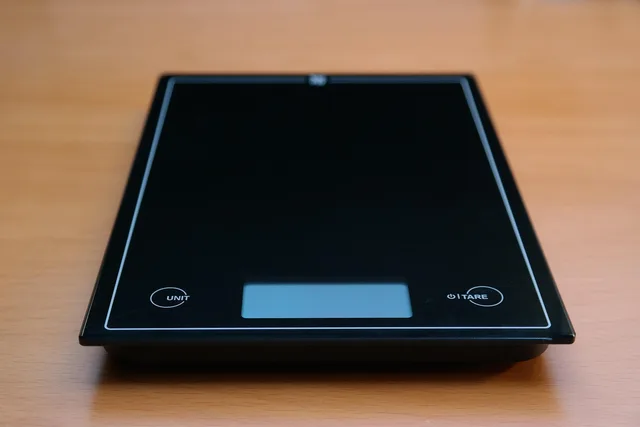
Two scales do the job better than one. The Escali Primo reads in 1-gram steps and tares, typically about $25. The American Weigh Scales AWS-1KG reads in 0.1-gram steps, typically $20 to $30.
A 0.1-gram scale is enough for the salt in a 2-kilogram batch of cabbage. Tested recipes commonly call for 2 to 3 percent salt by weight, or 20 to 30 grams per kilogram of vegetables.
The lid and the weight do the quiet work
Vegetables held under brine ferment evenly. Vegetables poking above the surface meet air, and that is where film yeasts and mold start.
An airlock lid vents carbon dioxide and keeps oxygen out. A weight, glass or ceramic, holds the pack down. Both are cheap and both are washed between batches.
The Kraut Source lid fits a wide-mouth Mason jar and uses a spring-loaded stainless follower to press the vegetables down, typically about $35. Masontops Pickle Pebbles are glass weights sold in sets, typically under $20. A standard three-piece brewing airlock and a drilled grommet lid cost a few dollars.
The failure this prevents is the one home fermenters report most: a good batch with a bad top layer. Skimming does not fix the flavor underneath.
The meter only counts if it is calibrated
A pH meter reads the acidity that tells you a ferment has moved past the point where spoilage organisms and pathogens of concern grow. That reading is only worth the calibration behind it.
The usual line is pH 4.6. Below that, Clostridium botulinum does not grow, and a fully soured sauerkraut often lands near 3.5.
Store the electrode in storage solution, not distilled water. Calibrate against fresh buffer before a session. Replace the electrode on the maker's schedule, not when it stops responding.
Apera Instruments sells the PH20 as a pen with a replaceable electrode, typically about $50, plus pH 4.00 and 7.00 buffer refills. The Hanna Instruments HI98103 Checker calibrates on pH 7.01 and 4.01 buffers and typically costs $45 to $60.
If you are not going to calibrate, skip the meter and buy a second crock instead. A number you cannot trust is worse than no number. Bluelab's pH Pen adds a temperature readout and typically runs over $100, and no pen fixes a stale calibration.
The crock is a batch-size decision
A one-liter jar and a ten-liter crock are not the same tool at different scales. The crock holds temperature longer, takes a proper weight, and suits a household that ferments monthly.
The jar suits small trials, and it is the right place to test a new ratio before committing a season's cabbage to it.
Ohio Stoneware makes a two-gallon crock with a lid and weights, typically $60 to $90. Harsch Gairtopf builds a German water-seal crock, and a 10-liter one typically runs $150 to $250. Both take a weight that keeps the pack under brine without daily attention.
Cost is where the vessel question gets real. Our comparison of fermenting vessels covers what a jar and a crock each cost per liter of capacity, and the supply guide separates the purchases a batch requires from the ones a catalog suggests.
Where canning equipment overlaps
If you also can, two tools from that kitchen apply here. Penn State Extension's summary of time, temperature, and pressure in canning sets out why low-acid vegetables need pressure processing while high-acid pickles do not.
Illinois Extension's overview of canning covers headspace and the acidification rule that bottled lemon or lime juice substitutes for 5 percent vinegar where a tested recipe calls for it, while fresh juice does not, because its acidity varies.
A thermometer and a timer cross over. Neither is a fermentation tool, and both are worth having on the shelf.
Common questions
Which of the four matters most?
The scale. Salt concentration decides whether the batch ferments cleanly or spoils, and it is a weight relationship you can record and repeat.
Do I need a pH meter at home?
Only if you will calibrate it. With a tested recipe and a weighed salt ratio, the meter confirms what the recipe already controls.
How do I know a batch is off?
You do not diagnose spoilage from a description. Take a pH reading with a calibrated meter, or send a sample for laboratory testing, and ask your local public health authority.
Does a crock make better sauerkraut than a jar?
No. It makes more of it, at steadier temperature, with less fiddling. The ratio and the salt weight decide the flavor.
What does a starter set of the four cost?
Typically about $25 for a 1-gram kitchen scale, $20 for glass weights or an airlock lid, $50 for a pH pen, and $60 or more for a crock. That is roughly $155 before jars.
In this guide
- Fermentation tools without overdoing it: five borrow-or-buy callsFermentation tools without overdoing it: five calls on what to buy, borrow or skip, from a probe thermometer to the gear a licensed kitchen adds.
- 5 things worth knowing about fermentation tools tastingSome equipment choices reach the plate and most do not. A test design for finding out which is which, and the three that reliably change what you taste.
- 5 pointers on fermentation tool makers that hold upFive fermentation tool makers earn their place by function and spare parts, not by claims, and the one third-party check that exists is a canner gauge test.
- How to clean and store fermentation tools properly between batchesCleaning and storing fermentation tools between batches: airlocks, bungs, weights, crocks and gauges. Equipment left dirty or damp is a common reason a good recipe produces a bad jar.