Industry
Part of Kimchi as the third vegetable ferment: short, then refrigerated
How small producers ferment vegetables, and what home cooks copy wrong in 2027
Commercial vegetable fermentation is a controlled sequence of bacteria, not a craft mystery. What small makers actually control, and which parts do not scale down.
What to take away
Small producers control salt, temperature, and oxygen. Those are the same three levers a home cook has, at a different scale.
- A vegetable ferment is a relay. Different bacteria dominate in sequence, and each one sets up the next.
- Natural fermentation gives a more varied microbial population than a single added culture, which is where flavor complexity comes from.
- Scale changes spoilage risk. A 25 pound crock holds temperature better than a quart jar and dries out less at the surface.
The year in the title is a date stamp, not a change in the process. The bacteria, salt ratios and temperature ranges are the same in 2027 as they are now.
The relay, in order
The National Research Council's review of lactic acid fermentations sets out the sauerkraut sequence. Leuconostoc mesenteroides starts growth across wide temperature and salt ranges, producing carbon dioxide plus lactic and acetic acids that drop pH quickly. The volume is Applications of Biotechnology to Traditional Fermented Foods, published by National Academy Press.
Temperature vs. Fermentation Time
- 7.5 C (45 F)6 months
- 18 C (64 F)20 days
- 32 C (90 F)8-10 days
The carbon dioxide displaces air and creates the anaerobic conditions the rest of the fermentation needs. Lactobacillus brevis and Lactobacillus plantarum finish, with L. plantarum responsible for high final acidity.
That review gives temperature numbers. At 7.5 C (45 F), fermentation is very slow and may not finish for six months, but at 18 C (64 F), total acidity reaches 1.7 to 2.3 percent in roughly 20 days.
At 32 C (90 F), similar acidity arrives in 8 to 10 days, and homofermentative bacteria produce most of the acid.
What a producer actually controls
Real Pickles, a worker-owned maker in Greenfield, Massachusetts, sells raw fermented vegetables made with salt rather than a starter culture.
- Salt, weighed rather than measured by volume, batch after batch
- Room or cellar temperature, held inside a narrow band
- Oxygen exclusion, through vessel design rather than daily skimming
- Raw material specificationvariety, size, days since harvest
- A written record for every batch, so a failure can be traced
Natural populations are the point
Sequencing work on naturally fermented sauerkraut, including a high-throughput survey of Suan-cai from northeast China, finds Lactobacillus species widely present. Latilactobacillus sakei, Lactiplantibacillus plantarum and relatives are more abundant in the leaves than in the fermentation broth, alongside Pediococcus and Leuconostoc. The paper is open access on PubMed Central under record PMC10082884.
The same study detected some unwanted genera, a reminder that a natural ferment is a competition, not a guarantee.
What does not scale down
A 5 gallon crock of 25 pounds of cabbage has thermal mass. It holds its own temperature through a cold night, and its surface area is small relative to its volume. A quart jar has neither advantage, which is why extension guidance warns that jar fermentation loses more batches to spoilage.
Producers also handle the surface differently. A sealed water-groove crock or a proper airlock keeps oxygen out continuously, where a home jar under a towel needs skimming two or three times a week.
What home cooks copy wrong
- Salt measured by volume, so the ratio drifts with grain size, humidity and the brand of salt
- A towel over the jar instead of a water groove or airlock, which means skimming rather than oxygen control
- No written record, so a failed batch cannot be traced to salt, temperature or time
What to copy at home
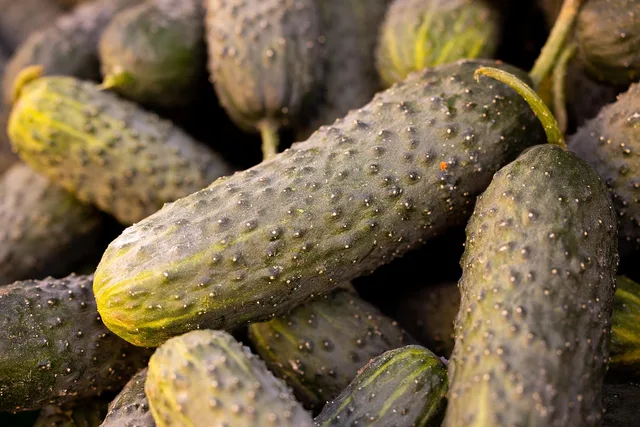
Copy the record keeping and the specification, not the vessel. Weigh your salt on a scale rather than measuring it by spoon. Buy one cucumber variety at one size and stay with it for a season.
Ferment in the same corner of the same room, and take a temperature reading at the same time each day. None of that costs money, and it is most of what separates a producer's consistency from a hobbyist's luck.
Our starting point guide covers the numbers, and the short list of vegetable ferments covers which projects are worth the effort.