Guides
Which Canadian wild berries are safe to ferment?
Saskatoons, lingonberries and lowbush blueberries ferment well; baneberry and nightshade do not. Match leaf, fruit scar and habitat before you pick.
What to take away
- Saskatoon berries, lingonberries, lowbush blueberries, cranberries and cloudberries are the Canadian wild fruit that ferment reliably, because each is edible raw and carries enough acid, sugar or both.
- Baneberry, red elderberry, honeysuckle and nightshade berries share habitat with edible fruit and do not belong in a jar.
- Most provinces allow personal picking on Crown land; parks, conservation areas and commercial harvest are separate questions answered by the province, not by a general rule.
- Weigh salt at 1.5 to 2 per cent of fruit plus water by weight, and keep the ferment between 18 and 22 degrees Celsius.
- Write species, location, date and weather at the picking site, because that page is what lets you repeat a batch or explain one that failed.
This site is about fermentation and preserved foods, so the useful question is not only which berries you can identify. It is which Canadian wild berries can go into a brine, a wild yeast jar, or a low-sugar preserve without spoiling.
For the fermenter, berry identification is not the destination. It is the first safety filter before fruit meets salt, brine, or a low-sugar preserve. A confirmed species tells you the expected acidity and sugar level, which in turn tells you how much salt to weigh, whether to add sugar, and how quickly to refrigerate.
The Canadian species below earn their place because they can be preserved by fermentation, not merely because they are edible. Read the foraging notes as production notes: what to pick, what to reject, and how each fruit behaves once it enters a crock, jar, or brine.
If you forage in the United States, the same salt, acid, and temperature checks carry over, but confirm your own state and federal rules. The notes below answer that. They cover safe species, salt and pH, temperature, and the records that let you repeat a batch. Read them as a preservation guide, not as a foraging guide alone.
Which wild berries ferment, and which stay out of the jar
Fermentable vs. avoid
Ferments well
- Saskatoon berry
- Yes
- Lingonberry
- Yes
- Lowbush blueberry
- Yes
- Cranberry
- Yes
- Cloudberry
- Yes
- Bunchberry
- No
- Bearberry
- No
- Baneberry
- No
Needs sugar
- Saskatoon berry
- No
- Lingonberry
- No
- Lowbush blueberry
- No
- Cranberry
- No
- Cloudberry
- No
- Bunchberry
- Yes
- Bearberry
- Yes
- Baneberry
- No
Toxic
- Saskatoon berry
- No
- Lingonberry
- No
- Lowbush blueberry
- No
- Cranberry
- No
- Cloudberry
- No
- Bunchberry
- No
- Bearberry
- No
- Baneberry
- Toxic
Edible but low-sugar fruit ferments poorly. Bunchberry and bearberry usually need added sugar to move at all. Fruit that is toxic, or toxic until cooked, is a different category entirely.
Acidity decides as much as sugar does. A lactic ferment needs the fruit to sit below pH 4.6, and most edible Canadian wild fruit does. Where you are unsure, a digital pH meter answers in seconds what a taste test cannot.
Climate sets the harvest. A late Prairie frost can take a Saskatoon crop to nothing, and a wet coastal summer in British Columbia dilutes sugar in trailing blackberry. Pick after a dry spell and start the ferment within a day or two.
Which wild berries ferment
| Berry | Region | Season | Ferment style |
|---|---|---|---|
| Saskatoon berry | Prairies, BC interior | Late June to August | Salt brine or wild yeast |
| Lingonberry | BC, Newfoundland, boreal Canada | August to September | Salt brine, low sugar |
| Lowbush blueberry | Atlantic Canada, Quebec | July to August | Salt brine or honey |
| Cloudberry | Newfoundland, northern Quebec | July to August | Salt brine |
| Chokecherry | Prairies, Ontario | August to September | Brine after pitting |
Saskatoon berries, from shrub to brine
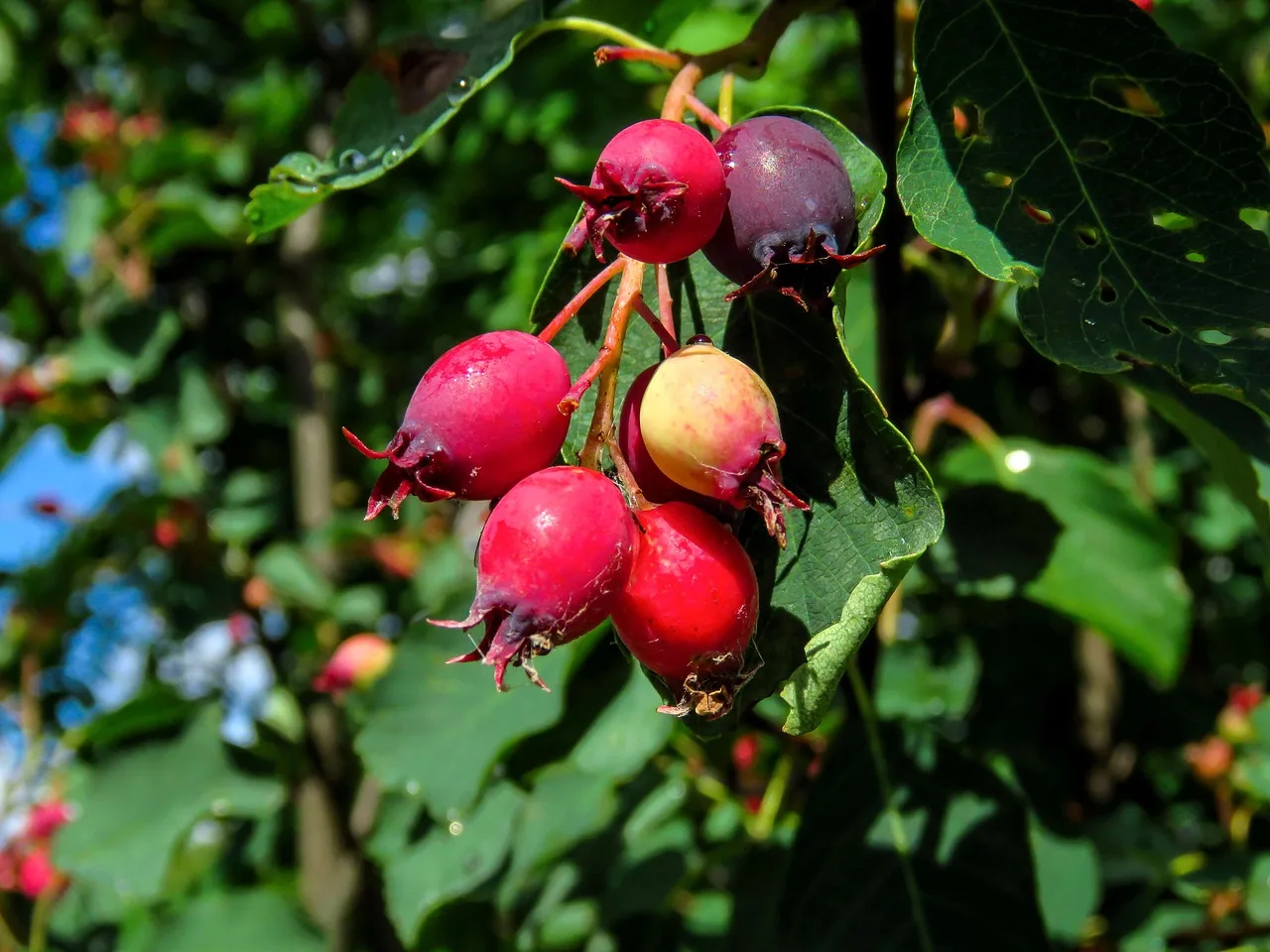
Saskatoon grows on a shrub two to five metres tall with smooth grey bark. The leaves are oval with fine teeth along the upper half. The fruit is a purple pome about the size of a pea, with a crown scar at the base like a small apple.
It colours from red to deep purple between late June and August, earlier in southern Saskatchewan and later in the BC interior.
The fruit carries enough sugar and acid to start on its own. Rinse, strip the stems, pack a clean jar, then add a 2 per cent salt brine by weight of fruit and water combined. Or mash the fruit, let wild yeast work two to three days, and salt after.
Hold the jar at 18 to 22 degrees Celsius, out of direct sun, and burp it daily. The ferment is ready when the brine turns slightly cloudy and the taste reads tart rather than sweet. Move it to the fridge at that point.
Saskatoons also drive a wild yeast soda. Mash a cup of berries with a tablespoon of sugar, cover with water, stir twice a day. Most kitchens see foam inside three days.
Lingonberries and lowbush blueberries
Lingonberry grows on low evergreen shrubs through the boreal forest, from Newfoundland and Labrador across Quebec into northern British Columbia. The berries are bright red, firm and sharply acidic, which puts them among the safest wild fruit to ferment. A lingonberry jar rarely spoils because the pH is already low.
That acidity means little salt is needed. A 1 to 1.5 per cent brine is enough. The result behaves more like a preserved condiment than a bubbly ferment, and it suits game, pork and root vegetables.
Lowbush blueberry is the wild form native to Atlantic Canada, Quebec and parts of Ontario and Manitoba. The berries run smaller and more intense than cultivated highbush fruit. A lightly crushed brine ferment holds colour better than a cooked preserve does.
Both freeze well before fermenting. Freezing breaks cell walls and releases juice, which shortens the ferment. Thaw, then proceed as normal.
Cranberries, cloudberries and chokecherries
Cranberry is the easiest native fruit to ferment because its acidity suppresses nearly everything unwanted. A plain salt brine works; many fermenters prefer a lightly sweetened one.
Cloudberry grows in Newfoundland, Labrador and northern Quebec. It is delicate and ferments best whole in a light brine within a day of picking. It does not travel.
Chokecherry needs care. The fruit is edible but the pits carry a cyanogenic compound, so pit them before fermenting and never crush the stones. Chokeberry carries similar tannin and is safe whole.
Wild raspberry and trailing blackberry ferment fast and often run alcoholic rather than lactic. Use them within a day, keep the brine stronger, and refrigerate early. When a vegetable ferment goes soft in the same way, the causes overlap with what makes Slimy fermented vegetables turn mushy and sour.
Red elderberry is toxic raw. Black elderberry is edible only after cooking, which makes it a poor candidate for a raw ferment. Cook it first if you use it at all.
- Fruit identified to species, not to colour
- No pits, stems or leaves in the jar
- Fruit rinsed in cool water, not soaked
- Salt weighed, not guessed
- Jar and weight cleaned and rinsed
- Date, place and weather written down
Toxic lookalikes and the three checks that catch them
Baneberry is the most common mistake. Its white or red berries grow in a cluster on a leafy plant, and the red form reads like red currant or highbush cranberry at a glance. The leaf is jagged, the root thick and fibrous, and every part is toxic.
Three checks before picking
Leaf shape: oval and fine-toothed?
likely true blueberry
stop, do not pick
Lookalikes do not share one map. Baneberry grows in moist woodland edges from Ontario to British Columbia and ripens alongside wild raspberry.
Honeysuckle berries are translucent red or orange and sit in pairs at the leaf axil. Up close they resemble no blueberry, but hurried pickers and children confuse them. Buckthorn berries are black, grow in dense clusters along the stem, often near water, and cause severe digestive upset.
Nightshade, black and bittersweet alike, produces small berries that can pass for wild blueberry. The leaves give it away: alternate and lobed or entire, never the fine-toothed oval of a true blueberry.
A worked example. You find a low shrub with small dark berries on a rocky slope in Nova Scotia in August. Check the leaf first. Oval, fine-toothed, borne on a woody stem, with a crown scar on the fruit, means lowbush blueberry.
If the leaf is lobed, or the fruit carries no crown, stop. If the berries sit in a tight umbel on a fleshy green stem, it is not blueberry at all.
Three checks catch most mistakes: leaf shape, fruit attachment, growth habit. Photograph all three before you pick. If any check is unclear, leave the fruit on the shrub.
Provincial picking rules and where harvest is restricted
Foraging rules in Canada are set by province, and they differ more than most pickers expect. On Crown land, most provinces allow personal picking of wild fruit without a permit. Commercial harvest usually needs one.
A permit that works in one province means nothing in the next. Check the province where you are picking, not the one where you live.
Quebec handles wild food and agricultural rules through its agriculture and natural resources ministry, which publishes land use and harvesting guidance. The Quebec agriculture, environment and natural resources page is the starting point for what is allowed on provincial land.
Saskatchewan routes food processing and natural resource rules through its business and industry channels. The Saskatchewan agriculture, natural resources and industry page is where commercial pickers and small processors check requirements.
British Columbia splits land use, farming and resource rules across one portal. The BC farming, natural resources and industry portal covers the provincial land and food rules that apply to wild harvest businesses.
Federal statutes still govern anything sold. The Consolidated Acts index lists the pest control and food statutes behind provincial rules, including the Food Safety Regulations under the Safe Food for Canadians Act.
Selling a fermented wild berry product brings in the Canadian Food Inspection Agency and your provincial health authority, and cottage food rules in Ontario, Quebec and British Columbia each set their own sales caps. Confirm the current limits with the ministry that issues your licence.
National and provincial parks almost always ban picking, as do many municipal green spaces and conservation areas. Check the specific park before you go, not after.
Salt, sugar, acidity and temperature for wild fruit
Wild fruit is not uniform. Sugar, acid and water content shift with rainfall, sun and soil, so a recipe that worked last August can behave differently this year. Treat every recipe as a starting point.
Salt, sugar, pH and temperature
- 1.5-2%salt by total weight for most wild berries
- 1%salt for acidic fruit like lingonberry and cranberry
- 2%maximum added sugar by weight
- 4.6pH safety line for lactic ferment
Salt is the main control, and it gets weighed rather than measured by volume. For most wild berries, 1.5 to 2 per cent salt by total weight gives a stable ferment. Acidic fruit such as lingonberry and cranberry can go lower, to 1 per cent.
Sugar feeds the ferment and spoilage organisms alike. If a berry is low in sugar, add no more than 2 per cent by weight and stir to dissolve. Do not add sugar to a ferment that already smells of acetone or nail polish. That batch is finished.
Acidity is the safety line. Below pH 4.6 the ferment stays in safe territory. If your fruit is borderline, add a tablespoon of lemon juice per litre or blend in a handful of cranberries. Measure pH after 24 hours and again at the end.
Temperature matters more than most instructions admit. Above 24 degrees Celsius, wild fruit ferments can turn alcoholic or mushy within days. Below 16 degrees they may stall. Aim for 18 to 22.
If you want to branch out beyond fruit, the tested directions in these Vegetable ferment ideas apply the same salt and pH logic to other produce.
Keeping a harvest record that earns its keep
A wild harvest record is the only way to repeat a good ferment or explain a bad one. Write it at the picking site, not at home. Memory fades within hours.
Note the species, the exact location, the date, the weather in the days before picking, and the condition of the fruit. Dry or wet, fully ripe or slightly under, each changes the ferment.
Then record the ferment itself: salt percentage, temperature, container, and the day it started and finished. Taste notes matter too. A ferment that tasted right at day four may be too sour by day ten.
This is where fermentation jars trends and what a label cannot tell you both land, because a label shows a product name while your notes show the process. The sensory checkpoints in this fermentation supplies tasting guide are the ones worth writing down.
Keep notes in one notebook or one spreadsheet, not scattered across phone photos and scraps of paper. After two or three seasons you have a personal reference no general recipe can match.
Common questions
Can I ferment wild berries without adding salt?
Yes, for very acidic fruit such as lingonberry and cranberry, where the pH is already below 4.6.
For sweeter fruit like Saskatoon berries, salt at 1.5 to 2 per cent by weight is what keeps the ferment safe.
If you are unsure whether a finished batch is safe, take a pH reading or ask your local public health authority rather than guessing from taste.
Are all wild blueberries in Canada safe to ferment?
Lowbush and highbush blueberries are safe. Several unrelated plants produce small dark berries that are not, so confirm the leaf shape and the crown scar on the fruit before picking. Bittersweet and black nightshade are the two most often mistaken for blueberry.
Do I need a permit to pick wild berries in Canada?
For personal use on most Crown land, no. Commercial harvest, national and provincial parks, and many conservation areas require permission or ban picking outright. Rules are set by province, so check the ministry for the province you are picking in, not the one you live in.
How do I know a wild berry ferment has gone wrong?
Fuzzy mould, a slimy surface, or a smell of acetone, rot or sulphur are the signals to stop. A cloudy brine and a tart smell are normal. Discard anything you doubt, and have a doubtful batch tested rather than tasted.